A Las Vegas business owner with $3,000 a month for advertising has to pick a lane, at least at first. Split it evenly across Google and Meta and you usually end up with two accounts that never gather enough data to work properly. So the question is which platform earns the first dollar.
Most comparisons answer this by listing features. That is not useful, because the platforms are not really competing to do the same job. One reaches people who are already looking for what you sell. The other puts you in front of people who were not looking at all. Everything else, including the cost difference, follows from that.
Quick Answer
| Google Ads works better for businesses people actively search for, especially urgent services like plumbing, legal, dental, and HVAC. Meta Ads works better for visual, discretionary, and impulse driven offers, and for reaching a local audience that does not know you exist yet. Meta clicks are far cheaper, at $1.92 for lead campaigns against $5.42 on Google search, but Google clicks come from people with a problem they are trying to solve right now. |
Key Takeaways
- Google captures existing demand. Meta creates demand. Pick based on whether people already search for what you sell.
- Google search averages $5.42 per click. Meta lead campaigns average $1.92 and traffic campaigns average $0.70.
- Cheaper clicks do not mean cheaper customers. Compare cost per lead, then close rate, not cost per click.
- Meta needs creative volume. Google needs keyword and landing page discipline. Those are different kinds of work.
- For most Las Vegas service businesses, Google first and Meta second is the right order. Restaurants, salons, and event businesses often reverse it.
- Retargeting is where the two channels stop competing and start compounding.
The Real Difference: Capturing Demand vs. Creating It
The biggest difference between Google Ads and Meta Ads is when the customer becomes interested.
Google usually captures demand that already exists.
Imagine someone in Henderson whose air conditioner stops working in July. They open Google and search:
“emergency AC repair near me”
That person already has:
- A clear problem
- A reason to act now
- A budget in mind
- Very little patience
Google Ads helps you appear in front of that customer at the exact moment they are looking for a solution.
Meta works differently.
Someone scrolling Instagram at 9 p.m. is probably not actively searching for an air conditioning company. But they may stop scrolling when they see:
- A before-and-after video from a Summerlin med spa
- A great photo from a new restaurant on Rainbow Boulevard
- A fitness transformation from a local gym
- A limited-time offer from a salon or boutique
Ten seconds earlier, they were not thinking about buying anything.
Now they are.
That is demand creation rather than demand capture.
A simple way to decide between the two platforms is to ask:
Does someone with this problem normally type it into Google?
If the answer is yes, Google Ads will usually work harder for your budget.
If customers often do not know they want your product or service until they see it, Meta can do something Google cannot: create the interest in the first place.
What Each Platform Costs in 2026
The benchmark data below comes from WordStream by LocaliQ, one of the most widely cited public sources for paid advertising benchmarks.
The Google Search figures come from the 2026 Search Advertising Benchmarks, covering more than 13,000 U.S. campaigns run between April 2025 and March 2026.
The Meta figures come from LocaliQ’s Facebook Advertising Benchmarks, last updated in October 2025.
Because the reporting periods are different, these numbers should be used as directional benchmarks, not a perfect platform-to-platform comparison.
| Metric | Google search ads | Meta lead campaigns | Meta traffic campaigns |
| Average cost per click | $5.42 | $1.92 | $0.70 |
| Average click through rate | 6.64% | 2.59% | 1.71% |
| Average conversion rate | 8.18% | 7.72% | Not reported |
| Average cost per lead | $66.69 | $27.66 | Not reported |
Sources: LocaliQ 2026 search benchmarks and LocaliQ Facebook benchmarks. Meta cost per lead rose about 20 percent year over year, from $22.87 to $27.66.
Why the Cheaper Click Is Not Always the Cheaper Customer
At first glance, Meta looks much cheaper.
Compared with Google Search:
- Clicks cost significantly less
- Lead costs are less than half on average
- Meta can generate more lead volume for the same budget
That sounds like an easy decision.
It is not.
The real difference often appears after the lead comes in.
A Google Search lead may come from someone who typed:
- “personal injury lawyer Las Vegas”
- “emergency plumber near me”
- “dentist open today”
- “AC repair Henderson”
They are actively trying to solve a problem.
A Meta lead may come from someone who was interrupted while scrolling Facebook or Instagram and completed a pre-filled lead form in a few taps.
Both leads show up as one conversion inside an advertising dashboard.
But they may behave very differently once your sales team contacts them.
Google leads often have:
- Higher immediate intent
- A clearer problem
- More urgency
- Stronger buying motivation
Meta leads may produce:
- More volume
- Lower initial lead costs
- More casual inquiries
- Greater variation in lead quality
That does not mean Meta is worse.
It means you should not judge either platform by cost per lead alone.
You need to track:
Lead → Qualified Lead → Appointment → Sale → Revenue
For example, imagine:
- Meta costs $27.66 per lead
- Google costs $66.69 per lead
Meta looks dramatically cheaper.
But if Google leads close at twice the rate, the real difference in customer acquisition cost may be much smaller.
The best platform is the one that generates customers profitably not simply the one that generates the cheapest form submissions.
Cost Per Lead, Side by Side
Here is how Google and Meta compare across several industries common in the Las Vegas market.
| Business category | Google CPL | Meta CPL | What the gap tells you |
| Dentists and dental services | $72.97 | $76.71 | Effectively level. Dental is the one category where Meta clicks cost more, at $9.78, so lead quality decides it |
| Home and home improvement | $90.92 | $41.26 | Meta looks cheaper, but urgent repair demand only exists on search |
| Attorneys and legal services | $131.63 | $18.17 | The widest gap on the board. Meta legal leads are volume, Google legal leads are cases |
| Restaurants and food | $30.57 | $3.16 | Meta wins outright. Food is visual and impulse driven |
| Physicians and surgeons | $40.04 | $47.47 | Google is cheaper and better matched to intent |
| Beauty and personal care | $39.25 | $51.42 | Google cheaper on paper, though Meta creative can outperform for new treatments |
| Real estate | $102.51 | $16.61 | Meta far cheaper per lead, and known for lead quality variance |
| Personal services | $54.60 | $30.57 | Meta cheaper, and it works well for weddings, cleaners, and event services |
Google figures from the 2026 search benchmarks. Meta figures from the leads objective in the Facebook benchmark report. Compare the row that matches your business, and remember the two studies cover different periods.
Which Platform Fits Your Las Vegas Business?
Start With Google Ads If:
Google is usually the stronger starting point when customers are already searching for what you sell.
It is especially useful if:
- Your service is urgent or unplanned.
Think AC repair, plumbing, locksmiths, towing, emergency dental care, or water damage. - Customers deliberately compare providers.
Common examples include legal services, healthcare, accounting, contractors, and professional services. - Your average job value is relatively high.
If a new customer is worth hundreds or thousands of dollars, a $5 click may be a small cost compared with the potential return. - You need leads quickly.
Search ads can put your business in front of high-intent customers even if your organic rankings are still developing. - You have a strong landing page.
Search visitors make decisions quickly. Slow pages, vague messaging, or poor mobile experiences can waste expensive clicks.
Start With Meta Ads If:
Meta is often the better starting point when visuals, discovery, emotion, or impulse drive the sale.
It can be particularly effective if:
- Your service photographs or videos well.
Restaurants, salons, med spas, fitness studios, boutiques, venues, and cosmetic services are strong examples. - Customers buy emotionally or impulsively.
The purchase does not always begin with a search. - People do not know to search for your offer yet.
This is common with new products, new treatments, entertainment concepts, events, and discretionary services. - You are launching or promoting something.
Meta can be useful for openings, promotions, seasonal offers, events, and brand awareness campaigns. - You can consistently produce creative.
Strong photography, short-form video, customer stories, before-and-after content, and promotional creative matter heavily on Meta. 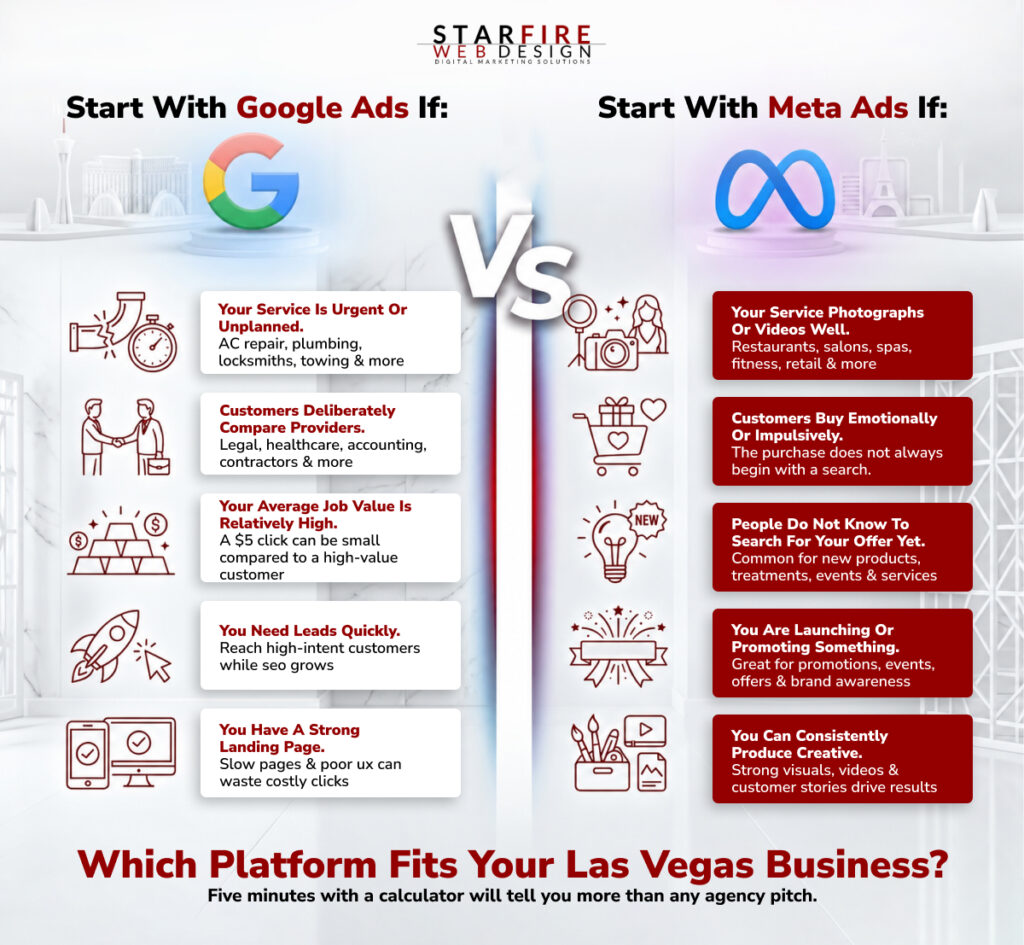
One Important Meta Cost Most Businesses Forget: Creative
Meta needs a steady supply of creative.The same advertisement cannot run forever.
Over time:
- Audiences become familiar with it
- Engagement drops
- Click-through rates fall
- Cost per result can increase
- Competitors introduce newer creative
That means Meta can become a content production problem before it becomes an advertising problem.
A business without good photos or video may have the right targeting and the right offer but still struggle because the creative is weak.
That is why we often connect Meta advertising with:
Meta works best when advertising and creative production are treated as part of the same system rather than as separate tasks.
The simplest way to think about it is this:
Google helps you show up when someone decides they need something. Meta can help create the moment when they decide they want it.
The Las Vegas Factor Nobody Accounts For
Las Vegas is not a normal local advertising market.
The city hosted 38,545,700 visitors in 2025, according to the Las Vegas Convention and Visitors Authority.
That matters because the same tourist traffic can be either:
- Wasted ad spend
- A valuable audience
It depends entirely on what your business sells.
For Google Ads, tourists can become expensive waste
Imagine someone staying in a hotel on Flamingo Road searches for:
“dentist near me”
If that person actually lives in Sacramento and only wants a dentist when they return home, a Las Vegas dental office gains nothing from that click.
But the advertiser still pays for it.
For local service businesses, especially those serving residents, location targeting needs to be handled carefully.
That usually means:
- Targeting people physically present in your service area
- Keeping the radius tight
- Reviewing search terms regularly
- Building a strong negative keyword list
- Excluding searches that show tourist or irrelevant intent
In Las Vegas, these are not minor account optimizations.
They can be the difference between a profitable campaign and one that quietly leaks budget.
For Meta Ads, tourists may be exactly who you want
Now take that same visitor and change the business.
A tourist staying near the Strip may be a strong prospect for:
- Restaurants
- Spas
- Tours and attractions
- Nightlife
- Boutiques
- Entertainment
- Local experiences
- Hospitality-related offers
In those cases, reaching people who are currently in Las Vegas — even if they live somewhere else — can be extremely valuable.
That is the key Las Vegas distinction:
The same visitor who is wasted spend for a plumber may be an ideal customer for a restaurant.
So the tourist question should be part of your platform strategy from the beginning.
If visitors are potential customers, Meta can give you another way to reach them.
If visitors are not your customers, Google requires tighter geographic controls, while local SEO can become the more cost-effective long-term way to capture resident demand.
What Each Platform Demands From You
Budget is only one part of the decision.
Google and Meta require different types of work, and many campaigns fail because the business underestimated what the platform would need after launch.
| Requirement | Google Ads | Meta Ads |
| The main lever | Keywords, negatives, and the landing page | Creative volume and audience signals |
| Ongoing work | Weekly search terms review, bid and budget checks | New photo and video assets every few weeks |
| Where accounts break | Broad match with no negative list, traffic sent to a homepage | Creative fatigue, and lead forms that let anyone through |
| Landing page | Essential. Page experience affects what you pay per click | Optional for lead forms, essential for traffic campaigns |
| Time to useful data | Two to four weeks with adequate click volume | Similar, but it needs several creative variations to compare |
| Lead quality risk | Lower. Intent is built into the search | Higher. Frictionless forms produce some unqualified leads |
What Google requires
Google Ads depends heavily on intent control.
You need to keep answering questions such as:
- Which searches are actually producing leads?
- Which search terms are wasting money?
- Are broad match keywords becoming too loose?
- Are ads sending people to the right page?
- Which keywords are producing customers rather than just clicks?
One of the biggest mistakes is paying for high-intent traffic and then sending it to a generic homepage.
The ad may be specific.
The search may be specific.
The landing page should be specific too.
We cover that problem in more detail in 10 landing page mistakes that kill conversions.
What Meta requires
Meta has a different problem: creative fatigue.An ad can work well at first and then slowly decline as the audience sees it repeatedly.
That means successful Meta campaigns usually need a steady supply of:
- New images
- Short-form videos
- Different hooks
- New headlines
- New offers
- Customer stories
- Before-and-after content
- Multiple ad variations
Be Careful With Automation on Both Platforms
Automation can help, but it should not replace quality control.
On Meta
Advantage+ features can expand targeting and sometimes improve reported campaign metrics.
But broader delivery can also mean lower-quality leads if the system is optimizing for the easiest form submission rather than the best customer.
Native lead forms add another risk because they can be completed very quickly.
To improve lead quality, consider:
- Adding qualification questions
- Using conditional form logic
- Asking about budget, timing, or service needs
- Blocking low-quality or throwaway email domains where practical
- Sending leads into a CRM quickly
- Tracking which leads become actual customers
The campaign should ultimately be judged on:
Revenue and closed business not total form submissions.
On Google
The equivalent mistake is letting targeting expand too far or sending paid traffic to weak pages.
Watch for:
- Loose broad-match targeting
- Missing negative keywords
- Search terms outside your service
- Competitor or informational searches with no buying intent
- Poor location settings
- Traffic going to a generic homepage
Automation is useful when it is working inside a well-managed account.
It is dangerous when nobody is checking what it is actually optimizing for.
The Case for Running Both
For many businesses, the best long-term strategy is not Google or Meta.
It is using the two platforms for different stages of the buying journey.
Here is a common example.
Someone searches:
“Las Vegas web designer”
They click a Google ad.
They look at your portfolio, pricing, or services.
Then they leave without calling.
At that point, the original Google click has not produced a lead.
But that person now knows your brand.
If they later see:
- A website redesign example on Instagram
- A client result on Facebook
- A short video explaining your process
- A testimonial or case study
Your business stays visible during the consideration period.
Google created the first interaction.
Meta helps keep the brand in front of the prospect.
That is where retargeting becomes valuable.
A Better Order for Using Both Platforms
Rather than launching everything at once, we usually recommend building the system in stages.
1. Get Google Search working first
Start by capturing existing demand.
Focus on:
- High-intent keywords
- Tight geographic targeting
- Strong landing pages
- Call and form tracking
- Search term reviews
- Cost per qualified lead
The goal is to understand what a real lead costs.
2. Add Meta retargeting
Once Google is bringing qualified visitors to the site, use Meta to reconnect with people who did not convert on the first visit.
Retargeting can help you:
- Stay visible
- Reinforce trust
- Show additional proof
- Bring visitors back
- Get more value from traffic you already paid for
3. Expand Meta into prospecting
Once your creative process is consistent, Meta can move beyond retargeting and begin reaching new audiences.
That is where you can test:
- New offers
- Video campaigns
- Before-and-after creative
- Lookalike audiences
- Lead campaigns
- Awareness campaigns
- Local promotions
This order reduces risk.
A modest advertising budget spread across two underfunded platforms often produces less useful data than one platform run properly.
Get one channel working.
Understand your numbers.
Then add the second channel for a specific reason.
If you want to understand the economics of that first step, we break them down in our guide to what Google Ads cost for a Las Vegas business.
How to Decide This Week
- Search for your own service in Google with a Las Vegas modifier. If there are ads there and the volume is real, demand exists and Google can capture it.
- Ask whether your last ten customers found you because they had a problem, or because they saw something appealing. That answer usually settles the platform.
- Look at what creative you actually have. No photo or video library means Meta will stall in month two.
- Compare your industry cost per lead on both platforms in the table above against what a customer is worth to you.
- Fund one platform properly for 90 days with conversion tracking installed, then add the second as retargeting.
Starfire Web Design runs both channels for Las Vegas businesses, along with the landing pages and the photo and video work each one needs, so we have no reason to talk you into the platform that fits us rather than you. If you want a recommendation based on your category and your customer value, contact our Las Vegas team.
Frequently Asked Questions
Are Google Ads better than Facebook ads?
Neither is better in general. Google Ads performs better when people actively search for what you sell, which covers most urgent and considered services. Meta Ads performs better for visual, discretionary, and impulse purchases, and for reaching people who do not know your business exists. The right answer depends on whether demand for your service already exists in search.
Which is cheaper, Google Ads or Meta Ads?
Meta is cheaper per click and per lead. Meta lead campaigns average $1.92 per click and $27.66 per lead, against $5.42 per click and $66.69 per lead on Google search. Cost per customer often narrows or closes that gap, because search leads usually arrive with more intent and close at a higher rate.
Should a small business use Google Ads or Meta Ads first?
For most Las Vegas service businesses, Google first. Search demand is measurable before you spend, so you can forecast results with less guesswork. Restaurants, salons, studios, and event businesses are usually the reverse, because their offers sell visually and their customers are not searching.
Can I run both on a small budget?
Not well, and not at the same time. Splitting a modest budget across two platforms usually means neither collects enough conversion data to optimize. Fund one properly, get it to a predictable cost per lead, then add the second, starting with retargeting because it is the cheapest way in.
Why are my Meta leads worse quality than my Google leads?
Because the two leads did different amounts of work to reach you. A Google lead searched for a solution and clicked through. A Meta lead form can be completed in two taps while someone is scrolling. Add qualifying questions to the form, use conditional logic, and measure closed business rather than lead volume.
Does Meta advertising work for local service businesses in Las Vegas?
Yes, in two roles. Retargeting people who already visited your site, and building awareness in specific neighborhoods before demand exists. It is weaker at capturing urgent need, since nobody scrolls a feed while their pipe is leaking. For urgent trades, pair it with Google search or with Local Services Ads, which charge per lead rather than per click.
How does the Las Vegas tourist market change the answer?
It cuts both ways. For local service businesses, visitor traffic is waste that has to be excluded from Google targeting. For restaurants, spas, retail, and entertainment, visitors are the customer, and Meta can reach people currently in the area regardless of where they live.
What about Instagram, TikTok, and the rest?
Instagram sits inside Meta Ads, so running Meta usually means running both feeds. TikTok and the others are additional channels worth testing once one paid channel is profitable, not before. Our social media marketing services cover the platform mix and the creative that any of them require.