Ask an agency whether Google Ads are worth it and you already know the answer you will get. So here is a different one: for some Las Vegas small businesses, paid search is the fastest and most predictable lead source available. For others, it is a monthly bill with nothing attached to it, and we tell those businesses not to start.
The difference between those two outcomes is not luck, and it is not the size of the budget. It comes down to three conditions that you can check before you spend anything. This article walks through all three, shows the math, and is specific about when the answer is no.
The Quick Answer
| Google Ads are worth it for a Las Vegas small business when three things are true: a new customer is worth more than your industry cost per lead, you can track a conversion accurately, and paid clicks land on a page built to convert. With an all industry average cost per lead of $66.69 in 2026, a business whose customers are worth thousands has room to profit. A business with a $60 average sale and no tracking does not. |
Key Takeaways
- Worth it is a math question, not an opinion. Compare customer value against cost per lead before anything else.
- The average cost per lead across industries in 2026 is $66.69, and cost per click averages $5.42.
- Without conversion tracking, Google cannot optimize and you cannot judge results. This alone disqualifies most failed accounts.
- A weak landing page is the most common reason Las Vegas ad spend underperforms, and it is fixable without touching the campaign.
- If your total monthly budget cannot support 10 to 20 clicks a day at your cost per click, the account will learn too slowly to be useful.
- Local SEO and a fully built Google Business Profile are often the better first investment for a business under that threshold.
The Three Tests That Decide It
Before spending a dollar on Google Ads, your business should be able to pass three basic tests:
- The economics work.
- Conversions can be tracked.
- The landing page can turn clicks into leads.
If one of these fails, increasing the ad budget usually makes the problem more expensive rather than solving it.
Test One: Is a Customer Worth More Than a Lead Costs?
The question: Can you acquire a customer profitably?
This is the one test that better campaign management cannot fix.
Start with your likely cost per lead. WordStream by LocaliQ analyzed more than 13,000 U.S. search campaigns running from April 2025 through March 2026 and reported:
- Average cost per lead: $66.69
- Average cost per click: $5.42
- Average conversion rate: 8.18%
Then compare your acquisition cost with what a new customer is actually worth.
For example, a dental practice in Summerlin paying roughly $73 per lead and closing about 40% of those leads would spend around $183 to acquire a patient. If that patient is worth several times that amount during the first year, the economics make sense.
A boutique selling $45 products, with little repeat business and a $39 cost per lead, has a very different equation. The numbers may simply not leave enough margin.
Quick Profitability Check
| Business type | Avg. cost per lead | Typical close rate | Cost per customer | Verdict |
| Personal injury firm | $131.63 | About 10% | About $1,316 | Worth it, case values are high |
| HVAC or home improvement | $90.92 | About 40% | About $227 | Worth it on most jobs |
| Dental practice | $72.97 | About 40% | About $182 | Worth it on patient value |
| Auto repair shop | $29.96 | About 50% | About $60 | Worth it, low lead cost |
| Low ticket retail, no repeat | $30 to $50 | Varies | Often above margin | Usually not worth it |
Cost per lead figures from the 2026 WordStream by LocaliQ benchmarks. Close rates are illustrative and you should use your own.
Pass this test if: your expected customer value comfortably exceeds your customer acquisition cost.
Fail this test if: you need unrealistically high close rates or repeat purchases just to break even.
Test two: can you measure a conversion?
Test Two: Can You Measure a Conversion?
The question: Can Google tell the difference between a valuable click and a wasted one?
Modern Google Ads relies heavily on automated bidding, and automated bidding relies on conversion data.
Google states in its documentation that Smart Bidding requires conversion tracking. That data helps Google decide which auctions to enter, which users are more likely to convert, and how aggressively to bid.
Without reliable tracking, Google sees traffic but has very little information about which clicks actually produce business.
Before launching, you should be able to verify actions such as:
- Form submissions
- Phone calls
- Appointment bookings
- Quote requests
- Purchases
Your conversion setup also needs to distinguish between meaningful business outcomes and secondary actions.
Google’s conversion measurement guidance explains that choosing the wrong primary conversion actions can prevent Smart Bidding from optimizing toward the outcomes that actually matter.
Simple rule: if nobody can clearly explain how a Google Ads lead is recorded and verified, fix tracking before increasing ad spend.
Pass this test if: every important lead or sale triggers a verified conversion action.
Fail this test if: you are judging campaign performance mainly by clicks, impressions, or traffic.
Test three: does the page after the click do its job?
The question: Can your landing page turn paid traffic into enquiries or sales?
This is where businesses often have the most control and where large amounts of ad spend are either saved or wasted.
Imagine two Las Vegas businesses in the same industry both paying $8 per click.
If the first landing page converts at 4%, every 100 clicks generates about 4 leads.
If the second converts at 10%, the same 100 clicks generates about 10 leads.
Same traffic.
Same cost per click.
Very different cost per lead.
That means improving the landing page can sometimes create a bigger performance gain than trying to reduce CPC.
Your page should quickly answer:
- What do you offer?
- Why should the visitor choose you?
- Do you serve their location or need?
- What should they do next?
- Can they complete that action easily on mobile?
Landing page quality can also influence Google Ads performance because ad relevance and landing page experience contribute to the signals used in the ad auction.
A slow, confusing, or poorly matched page can therefore hurt you twice: fewer visitors convert, while your advertising efficiency can also suffer.
We cover the most common problems in 10 Landing Page Mistakes That Kill Conversions.
If your paid ads currently send visitors to a generic homepage, building a focused landing page is one of the first improvements worth testing.
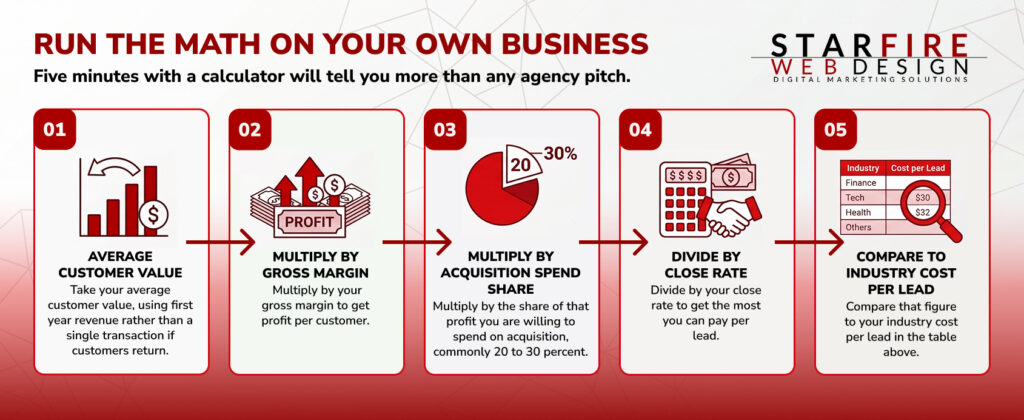
Run the Math on Your Own Business
Five minutes with a calculator will tell you more than any agency pitch.
- Take your average customer value, using first year revenue rather than a single transaction if customers return.
- Multiply by your gross margin to get profit per customer.
- Multiply by the share of that profit you are willing to spend on acquisition, commonly 20 to 30 percent.
- Divide by your close rate to get the most you can pay per lead.
- Compare that figure to your industry cost per lead in the table above.
Example:
A Las Vegas landscaping company has an average first year customer value of $2,800 at a 45 percent margin, so profit per customer is $1,260. Spending 25 percent of that on acquisition allows $315 per customer. At a 40 percent close rate, the allowable cost per lead is $126. The home improvement benchmark is $90.92. There is room, so the answer is yes, and the remaining work is execution.
Change one number and the answer flips. If the same company only closes 15 percent of leads, its allowable cost per lead drops to about $47, which is well under the benchmark. In that case the problem is not advertising, it is the sales process, and fixing the sales process is cheaper than buying more leads.
When Google Ads Are Not Worth It
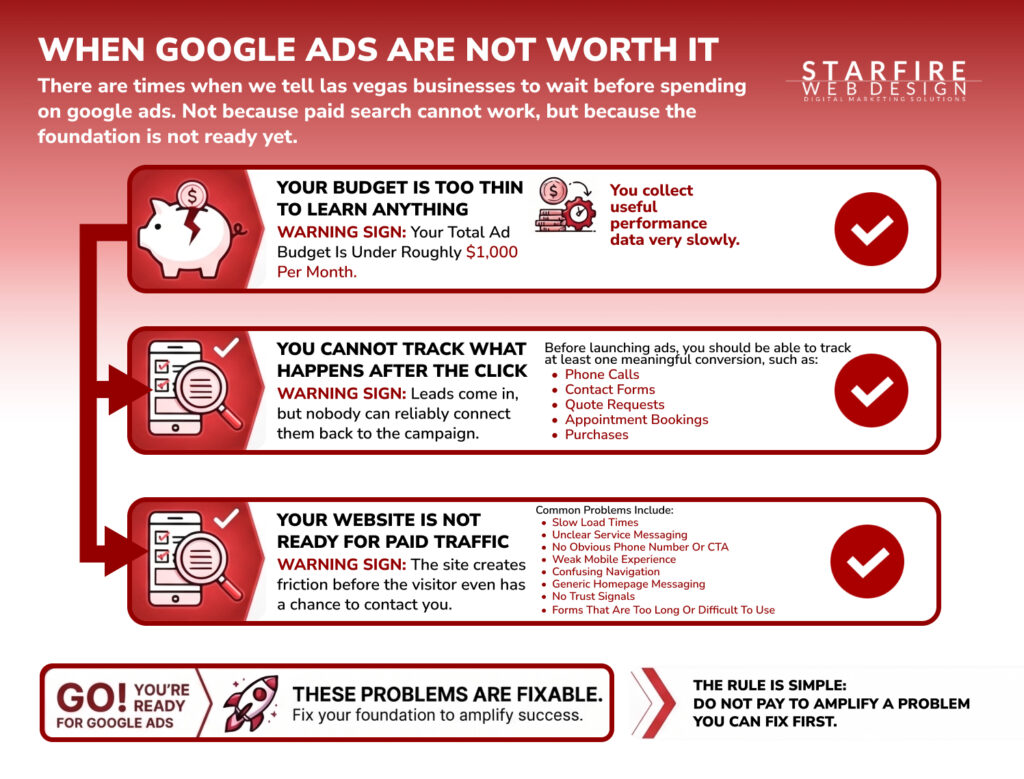
There are times when we tell Las Vegas businesses to wait before spending on Google Ads.
Not because paid search cannot work, but because the foundation is not ready yet.
1. Your Budget Is Too Thin to Learn Anything
Warning sign: your total ad budget is under roughly $1,000 per month.
Google does not require a minimum spend, but that does not mean every budget is practical.
If clicks in your market cost $8 and your daily budget is $15, you are buying fewer than two clicks per day.
That creates two problems:
- You collect useful performance data very slowly.
- It takes much longer to identify which keywords, ads, audiences, and landing pages are actually working.
A small budget can still generate leads, but in a competitive Las Vegas market, very low spend often means the campaign takes too long to produce enough data for confident decisions.
Fix this first: make sure the available budget can generate enough traffic and conversions to evaluate performance within a reasonable period.
2.You Cannot Track What Happens After the Click
Warning sign: leads come in, but nobody can reliably connect them back to the campaign.
This is different from choosing not to track.
If calls go directly to a mobile phone nobody logs, forms are not tracked, and there is no booking or CRM system recording lead sources, you cannot tell which part of your ad spend produced results.
That makes optimization mostly guesswork.
Before launching ads, you should be able to track at least one meaningful conversion, such as:
- Phone calls
- Contact forms
- Quote requests
- Appointment bookings
- Purchases
Fix this first: get conversion tracking and lead attribution in place before increasing traffic.
3.Your Website Is Not Ready for Paid Traffic
Warning sign: the site creates friction before the visitor even has a chance to contact you.
Common problems include:
- Slow load times
- Unclear service messaging
- No obvious phone number or CTA
- Weak mobile experience
- Confusing navigation
- Generic homepage messaging
- No trust signals
- Forms that are too long or difficult to use
Paid traffic is especially unforgiving because you are paying for every visitor who encounters those problems.
A weak website does not become stronger because more people see it. It simply wastes more of the budget.
Fix this first: improve the page experience before paying to send more traffic to it.
These Problems Are Fixable
None of these situations means Google Ads will never work for your business.
They simply mean something else should come first.
In most cases, fixing the website, conversion tracking, or sales infrastructure costs less than trying to advertise around those weaknesses.
If your website is the main blocker, a Las Vegas website design engagement or a focused website redesign can improve the foundation before you increase paid traffic.
The rule is simple:
Do not pay to amplify a problem you can fix first.
Why Google Ads Fail Most Often in Las Vegas
Las Vegas has a targeting problem most markets do not.
The city welcomed 38.5 million visitors in 2025, and many search for local services while they are here. Loose location settings can therefore send your ads to tourists who are not real prospects.
The most common problems we see are:
- Geographic targeting that is too broad
- No negative keyword list
- Paid traffic sent to a generic homepage
These are setup problems, not proof that Google Ads does not work.
Use presence-based targeting, build negative keywords early, and send traffic to focused landing pages.
Pairing this with local SEO can strengthen both paid and organic visibility in the areas that actually matter.
Where Google Ads Earn Their Keep
Paid search does something no other channel does as well. It puts you in front of someone at the exact moment they are trying to solve the problem you solve. Nothing about brand awareness or nurturing is involved. Somebody in Henderson types emergency AC repair at four in the afternoon in July, and you are either there or you are not.
That makes paid search strongest for urgent or high intent services, for businesses that are invisible organically and need leads this quarter, for testing whether a new service has demand before building pages around it, and for filling gaps while SEO matures. It is weakest for low value transactions, for long consideration purchases with no immediate trigger, and for businesses that cannot answer the phone when it rings.
What to Do Instead If You Are Not Ready
A no on paid search is not a no on growth. In roughly this order:
- Complete your Google Business Profile with categories, services, photos, and a steady flow of reviews. For local service searches, map pack visibility often outperforms paid ads and costs nothing per click.
- Get conversion tracking installed, including call tracking, so you have data before you spend.
- Fix the landing experience: speed, clarity, one obvious action, and a visible phone number.
- Build organic visibility through Las Vegas SEO. It takes months, and it does not stop working when you stop paying.
- Then revisit paid search with the measurement and the pages already in place. Accounts launched in that order cost less per lead from the first week.
The Honest Recommendation
Do the math before you do anything else. Customer value, margin, close rate, allowable cost per lead, then compare it to your benchmark. If the numbers leave room, paid search is likely worth it and the remaining risk sits in targeting, tracking, and the landing page. If they do not, no amount of campaign management will fix that, and you are better off putting the same money into your Google Business Profile, your site, and organic visibility.
READY TO FIND OUT WHAT GOOGLE ADS SHOULD COST YOUR BUSINESS?Starfire Web Design will review your market, customer value, close rate, and expected cost per lead to help you set a realistic paid-search budget. |
Frequently Asked Questions
Are Google Ads worth it for small businesses?
Yes, when a new customer is worth more than your industry cost per lead, conversion tracking is in place, and paid clicks land on a page built to convert. With an average cost per lead of $66.69 across industries in 2026, businesses with higher customer values have room to profit. Low ticket businesses without repeat purchases usually do not.
How much do small businesses need to spend on Google Ads?
Enough to support 10 to 20 clicks per day at your industry cost per click, which for most Las Vegas service businesses means $1,500 to $6,000 per month in ad spend, plus management. Google enforces no minimum, but budgets below roughly $1,000 a month collect data too slowly to optimize well.
Is Google Ads better than SEO for a small business?
They solve different problems. Paid search delivers visibility today and stops when the budget stops. SEO compounds over months and keeps working. Businesses that need leads this quarter usually run ads while SEO builds underneath, then shift the mix as rankings hold.
Why did Google Ads not work for my Las Vegas business?
The three most common causes are geographic targeting wide enough to serve ads to tourists searching for services in their home cities, no negative keyword list, and paid traffic sent to a homepage instead of a dedicated landing page. All three are setup issues and all three are fixable.
Can I run Google Ads without a good website?
You can, and it is the most expensive mistake in paid search. The ad buys the click and the page decides whether it becomes a lead. A page converting at 4 percent instead of 10 percent more than doubles what every lead costs you, on the same spend.
How long should I test Google Ads before deciding?
Give it 90 days with tracking in place and a budget that supports meaningful daily click volume. Expect the first two to four weeks to produce data rather than profit. Judging an account at week two is judging the learning phase.
Are Local Services Ads a better option for a small business?
For home services, legal, and similar local trades, often yes. Local Services Ads charge per valid lead rather than per click, and you can dispute charges for spam or clearly out of area leads. Google is moving them into Performance Max campaigns with pay per lead goals while keeping that model. Most valley home service businesses end up running both.