

The Healthcare Website Problem Nobody Is Talking About
Las Vegas is one of the fastest-growing healthcare markets in the Southwest. Clark County’s population crossed 2.3 million in recent years, and the demand for primary care, dental, and specialty services in growing neighborhoods like Portland, Henderson, and Green Valley continues to outpace supply. For medical and dental practices in this market, a website is not optional marketing infrastructure. It is the front door of your business.
And most practice websites are getting it wrong in very specific, fixable ways.
This is not a generic “why you need a website” article. Those fill the first page of Google results for healthcare web design terms, and they all say the same things. This guide is written specifically for Las Vegas practices: the regulatory landscape, the patient behavior patterns in this market, what the top-ranking competitors for your keywords are doing that you are not, and what a properly built Las Vegas website design actually delivers for a medical or dental practice.
WHO THIS GUIDE IS FORPrimary care physicians, family medicine practices, dentists, orthodontists, oral surgeons, dermatologists, chiropractors, physical therapists, urgent care centers, optometrists, and allied health practices operating in Las Vegas. |
How Las Vegas Healthcare Patients Actually Search
The patient journey to a healthcare appointment starts online in the vast majority of cases. According to Google and Compete’s 2012 Hospital Study, 77% of patients used search before booking an appointment. In Las Vegas, where residents have historically had fewer physician options per capita than the national average, the competition for visible digital presence is high.
Understanding how a Las Vegas patient searches changes how you build your website. There are three distinct search behaviors, and your site needs to handle all three.
Search Type 1: Neighborhood-First Discovery
A growing percentage of Las Vegas healthcare searches include a neighborhood or suburb modifier. “Dentist in Portland,” “family doctor Henderson NV,” “chiropractor Spring Valley Las Vegas” are all common queries. Patients in a city this geographically spread out think in neighborhoods first and city second. A website that says “Las Vegas dentist” throughout but never mentions Summerlin is invisible to the patient searching from their Summerlin neighborhood.
Search Type 2: Specialty or Symptom Driven
Patients searching for a specialist or with a specific concern use queries like “pediatric dentist near me,” “cosmetic dentist Las Vegas,” “urgent care Henderson NV open now,” or “dermatologist acne treatment Las Vegas.” These searches have strong commercial intent and high conversion rates when your website matches the specific service they are looking for. A generic practice website that lists specialties as a comma-separated sentence in the About page cannot capture this traffic.
Search Type 3: Brand Validation
A patient who received your name from a friend, saw your ad, or found you through insurance verification will search your practice name to check you out before calling. This is the highest-intent search category.
These patients are not deciding whether to seek care. They are deciding whether to call you or the next name on their list. If your website loads slowly, looks outdated, or does not immediately display your credentials and accepting-patients status, you lose this patient to a competitor who already has your referral.
PATIENT SEARCH REALITYThe majority of healthcare searches happen on mobile devices. Google research found that 44% of hospital researchers who used a mobile device scheduled an appointment, compared with 34% of computer-only researchers. For neighborhood searches and urgent care queries, that number climbs higher. If your practice website is not optimized for mobile viewing and one-tap calling, it is failing the majority of your prospective patients. |
The Patient Journey Mapped to Your Website
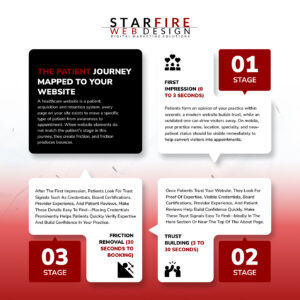
A healthcare website is a patient acquisition and retention system. Every page on your site exists to move a specific type of patient from awareness to appointment. When website elements do not match the patient’s stage in this journey, they create friction, and friction produces bounces.
Stage 1: First Impression (0 to 3 Seconds)
A new patient landing on your homepage for the first time makes a subconscious judgment about your practice within seconds. Research on first impressions of healthcare websites consistently shows that patients use visual design quality as a proxy for care quality. A dated website does not just look old. It communicates that the practice may not be keeping up with current standards.
What should happen in the first three seconds: the patient sees your practice name, location (neighborhood + Las Vegas), primary specialty, and whether you are accepting new patients. These four things must be visible without scrolling on a phone screen. If they are not, a percentage of patients who arrived with intent to book will leave.
Stage 2: Trust Building (3 to 30 Seconds)
If the first impression clears the bar, patients move to credential verification. They want to know: who is this provider, are they qualified, and have other patients trusted them? This stage requires visible credentials, a clear provider bio with medical school and board certifications, and accessible patient reviews.
The most common mistake at this stage is the credential burial. Provider credentials appear in the third paragraph of an About page, after two paragraphs about the practice philosophy. Patients are not reading that far before they make a trust judgment. Credentials belong in the hero section, in the header, or in the first viewport of the About page.
Stage 3: Friction Removal (30 Seconds to Booking)
Once a patient has decided to pursue an appointment, three things will determine whether the conversion completes on your website or abandons: insurance verification, appointment availability signal, and the booking mechanism itself.
Insurance: “We accept most major insurance” is not good enough. Patients want to see their specific carrier listed. A patient whose carrier is not explicitly listed will assume you do not take their insurance and leave rather than call to verify. List your carriers. Update the list when it changes.
Availability: “Call for an appointment” with no indication of wait time creates anxiety. New patients comparing multiple practices will favor the one that signals shorter wait times. Phrases like “New patients typically seen within 5 business days” or “Same-week appointments available” convert significantly better than a bare phone number.
Booking mechanism: Patients browsing at 9pm cannot be served by a phone-only practice. Online appointment requests or booking tools are now standard expectations in healthcare. Practices that require a phone call to initiate contact lose patients who browse outside business hours.
HIPAA and Your Las Vegas Practice Website: What Actually Applies
The Health Insurance Portability and Accountability Act (HIPAA) applies to covered entities, which include most healthcare providers who transmit health information electronically. The HHS HIPAA Security Rule specifically governs electronic protected health information (ePHI), which includes any individually identifiable health information transmitted or stored electronically.
When your practice website collects patient information through contact forms, appointment request forms, or online intake forms, HIPAA compliance requirements apply to how that data is collected, transmitted, and stored.
What This Means for Your Website Specifically
The HIPAA Security Rule requires covered entities to implement technical safeguards to protect ePHI. For a practice website, this translates to three concrete requirements: encrypted data transmission (HTTPS with TLS encryption), secure form handling that protects submitted patient information, and a Business Associate Agreement (BAA) with any third-party vendor that processes patient data on your behalf, including your web hosting company and your form processing platform.
| COMPONENT | COMPLIANT APPROACH | COMMON MISTAKE |
| Form handling | HIPAA-compliant form tools with encryption at rest and in transit (e.g., Halaxy, Jane App, or HIPAA-compliant Gravity Forms with encrypted add-on) | Standard Gravity Forms or Contact Form 7 without encryption transmit data in plain text |
| Web hosting | HIPAA-compliant host that signs a BAA: AWS, Google Cloud, or specialized medical hosts | Standard shared hosting (Bluehost, GoDaddy, SiteGround) do not offer BAAs |
| Email notifications | Encrypted email or notification system that does not transmit PHI in plain text | Form submissions emailed as plain text with patient symptoms or health info |
| Website platform | WordPress can be made HIPAA-compliant with the right hosting, plugins, and configuration. It is not compliant out of the box. | Assuming WordPress is automatically compliant because the contact form asks for a name and email |
| Third-party tools | All analytics, chat widgets, and marketing tools must be HIPAA-compliant if they can access form data; BAAs required | Installing Google Analytics or live chat tools without assessing PHI exposure |
The BAA Requirement
A Business Associate Agreement is a legally required contract between a covered entity (your practice) and any vendor that creates, receives, maintains, or transmits ePHI on your behalf.
This includes your web host, your form processing platform, and any third-party service that handles patient data. If your current web designer has never mentioned a BAA, and your hosting company has not signed one with you, your current website may be out of compliance regardless of how secure it looks. The HHS guidance on Business Associate Agreements is publicly available and worth reviewing with your practice administrator.
What HIPAA Does Not Prohibit
HIPAA does not prohibit having a professional website, displaying patient reviews with written consent, using online appointment scheduling, or running Google Ads for your practice. The compliance requirements apply to how patient-submitted health information is handled, not to the existence of a digital presence. Many practices over-restrict their web presence based on a misunderstanding of what HIPAA actually requires.
Worth knowing :HIPAA does not prevent patients from voluntarily leaving Google or Yelp reviews. It does restrict how practices respond to reviews. A practice cannot confirm that a reviewer is a patient or disclose any health information in a response, even to correct a factually inaccurate negative review. Responses should be generic: “We take all patient feedback seriously and invite you to contact our office directly to discuss your experience.” |
Medical Practice Websites: What Physicians and Clinics Need
Medical practice websites serve a more complex navigation challenge than most local business websites. Patients arrive with different intentions: some need a primary care physician and are willing to establish care, some need a specific specialist referral, some are evaluating urgent care options, and some are existing patients looking for patient portal access or after-hours information.
A well-structured medical practice website handles all four of these visitor types without burying any of them three clicks deep.
Homepage Architecture for Medical Practices
- Accepting new patients status at the top of the page, updated whenever status changes. This is the single highest-impact trust signal for a new patient searching for a provider.
- Primary specialty and sub-specialties stated clearly in the hero section, not in a sidebar.
- Neighborhood and city explicitly stated: “Primary care in Henderson, NV” not “serving the Las Vegas area.”
- Insurance carriers listed on the homepage or a clearly linked Insurance page, not behind a call-to-action that requires a phone call to check.
- Provider photo and credentials in the first viewport for single-physician practices. For group practices, a link to the provider directory that does not require multiple clicks.
- Appointment booking or request form accessible from the header on every page, not just the contact page.
- Patient portal link prominent for existing patients, separate from the new patient booking flow.
- After-hours and urgent guidance visible without searching. “For urgent concerns after hours, please call [number] or visit [urgent care location].”
Nevada Physician Licensing Display
Nevada physicians are licensed through the Nevada State Board of Medical Examiners. Osteopathic physicians are licensed through the Nevada Board of Osteopathic Medicine. While Nevada law does not mandate that physicians display their license number on their website, displaying it is standard professional practice and removes a common patient concern. Patients in Las Vegas, who may be evaluating multiple providers, will choose the practice whose credentials are most transparently presented.
ADA Accessibility for Medical Practice Websites
Healthcare websites have a heightened obligation for accessibility. The U.S. Department of Health and Human Services has applied Section 504 of the Rehabilitation Act to healthcare provider websites, requiring accessibility for patients with disabilities.
The practical standard is WCAG 2.1 AA compliance, which covers screen reader compatibility, color contrast ratios, keyboard navigation, and alt text for images. ADA Title III has also been applied to healthcare provider websites in federal court cases. A HIPAA-compliant website that is not accessible is still a legal and reputational risk.
Local SEO for Las Vegas Medical Practices
The local SEO mechanics for healthcare practices follow the same core framework as other local businesses: Google Business Profile optimization, consistent NAP (name, address, phone) across all directories, on-page keyword optimization, and review velocity. The healthcare-specific layer adds HIPAA-aware practices to each of these areas. This section covers the local search strategy. For a broader overview, see Starfire’s Las Vegas SEO services.
Google Business Profile for Healthcare Practices
The Google Business Profile (GBP) is the primary driver of local pack visibility for most healthcare practices. For queries like “dentist near me” or “family doctor Henderson,” the three businesses in the local map pack receive the majority of clicks. Getting into that pack, and staying there, requires a fully optimized and actively maintained GBP.
- Primary GBP category: Choose the most specific applicable category (“Dentist,” “Family Practice Physician,” “Chiropractor,” not the generic “Medical Clinic”).
- Services added individually in GBP: Each service you offer should be listed with a description. Google indexes these separately from your website content.
- Photos updated regularly: Interior, exterior, staff, and treatment area photos. GBPs with 10 or more photos receive significantly more engagement than those with fewer.
- Hours accurate and updated: Incorrect hours are one of the top reasons healthcare GBPs lose visibility and patient trust.
- Appointment link: Connect your GBP appointment URL to your online booking system or contact page.
- Review responses: Respond to every review, positive and negative, within 48 hours. Follow HIPAA guidelines on response content (do not confirm patient status).
Specialty-Specific Website Considerations
Different healthcare specialties have different patient acquisition patterns, different regulatory considerations, and different website priorities. The following covers the most common specialties in the Las Vegas market.
| SPECIALTY | PRIMARY WEBSITE PRIORITY | COMMON MISTAKE |
| General Dentistry | Accepting new patients status + online booking + insurance list | PDF forms only; no online booking option |
| Cosmetic Dentistry | Before/after gallery + service-specific pages + consultation CTA | Burying cosmetic services in a general services list |
| Orthodontics | Treatment options comparison (braces vs Invisalign) + payment plans | No financing information; patients self-disqualify on price assumptions |
| Dermatology | Condition-specific pages + cosmetic vs medical split + booking | One long services list with no search-intent differentiation |
| Chiropractic | Condition pages (back pain, neck pain, sports injury) + same-week availability | No condition-specific content; generic “we treat pain” messaging |
| Urgent Care | Hours + insurance accepted + wait time (if available) + directions | No real-time or estimated wait time; patients choose competitors with this info |
| Optometry | Online vision exam scheduling + eyewear gallery + insurance | No frame/lens inventory preview; patients shop elsewhere first |
| Physical Therapy | Condition and injury pages + referring physician info + insurance coverage | No content for referring physicians; missing an entire referral channel |
Five Non-Negotiables for Every Las Vegas Healthcare Website
1. Mobile First, Not Mobile Friendly
Mobile-friendly means the desktop site renders acceptably on a phone. Mobile-first means the site was designed for the phone experience first, and the desktop experience was built from that foundation. For healthcare, where mobile search accounts for the majority of new patient discovery, mobile-first design produces meaningfully better conversion rates.
2. Page Speed Is Patient Acquisition
A page that takes more than three seconds to load on a mobile connection loses a substantial portion of its visitors before they ever see your content. Test your current site at Google PageSpeed Insights and aim for a score above 85 on mobile.
Common culprits on healthcare websites: large uncompressed staff photos, poorly configured slider plugins, and multiple third-party scripts from scheduling tools, analytics, and live chat widgets.
3. Schema Markup for Healthcare
LocalBusiness schema markup tells Google what type of healthcare practice you are, where you are located, what hours you keep, and what services you offer. Healthcare practices should use the most specific schema type available: Dentist, Physician, MedicalClinic, and so on. This is the technical signal that supports local pack visibility and rich result features like star ratings in search snippets.
4. Reviews Are Your Referral Engine
For healthcare practices, the equivalent of word-of-mouth referrals is Google and Healthgrades reviews. According to BrightLocal’s Local Consumer Review Survey, 98% of consumers read online reviews for local businesses, and healthcare is among the highest-scrutiny categories. A practice with 60 Google reviews at 4.8 stars will consistently out-convert a practice with 12 reviews at 4.3 stars, even if the quality of care is identical.
5. Internal Linking Across Services
A patient who arrives on your teeth whitening page should be one click away from your cosmetic consultation page. A patient who reads your family medicine page should have a clear path to your pediatric services if they have children. Internal linking within a healthcare website builds topical authority for local search rankings and improves patient navigation. Every service page should link to at least two related pages and to your appointment booking flow.
Final words :
For Las Vegas medical practices, a high-performing website is no longer just a digital brochure. It needs to earn patient trust quickly, support HIPAA-aware communication, rank for local healthcare searches, and make booking as frictionless as possible.
Practices that invest in mobile-first design, clear service pages, visible credentials, compliant forms, strong review signals, and neighborhood-specific SEO are better positioned to turn online searches into scheduled appointments. In a competitive healthcare market, the practices that win online are the ones that make patients feel informed, confident, and ready to take the next step.
Ready to Build a Healthcare Website That Earns Patient Trust?Starfire Web Design builds HIPAA-aware, locally optimized websites for Las Vegas medical and dental practices. We understand the compliance landscape, the patient journey, and the search landscape. |
Frequently Asked Questions:
Does my Las Vegas practice website need to be HIPAA compliant?
Yes, if it collects patient health information through forms, appointment requests, or intake tools. That requires secure transmission, protected form handling, and Business Associate Agreements with vendors that process patient data.
What makes a healthcare website HIPAA compliant?
HIPAA-compliant hosting, encrypted form handling, signed BAAs with relevant vendors, and proper data handling procedures. WordPress can meet these standards, but only with the right setup.
How much does a medical or dental website cost in Las Vegas?
Basic medical or dental websites typically range from $3,500 to $7,000. More advanced sites with HIPAA-aware forms, service pages, provider profiles, and SEO strategy often range from $7,000 to $15,000+.
Can I respond to patient Google reviews without violating HIPAA?
Yes, but responses must stay general. Do not confirm patient status, mention treatment details, or reference appointment information. Invite the reviewer to contact the office directly.
How do I get my Las Vegas medical practice to rank in Google Maps?
Start with a fully optimized Google Business Profile, correct categories, listed services, updated photos, accurate hours, consistent NAP, local website optimization, reviews, and LocalBusiness schema.
Is it legal to use patient before-and-after photos on my Nevada dental website?
Yes, with proper written patient consent. Photos should accurately represent real outcomes and should not be digitally altered to exaggerate results.
What is the most important page on a medical practice website?
For new patients, the homepage and provider bio pages matter most. They should clearly show specialty, location, accepting-patient status, insurance information, and provider credentials.